The Liveline journal
What an after-hours inquiry actually costs you
A short, honest way to put a number on the inquiries that arrive when nobody is there to answer them.
- operations
- response-time

Most service businesses know, in a vague way, that they lose work at night. Someone messages the shop at 9:40 PM asking whether you can look at their car on Saturday, nobody sees it until the next morning, and by then the person has already booked somewhere else. It is a familiar annoyance. What it usually is not is a number.
That vagueness is expensive in a specific way: you cannot decide how much attention a problem deserves until you know its size. If after-hours inquiries cost you one job a year, ignoring them is the right call. If they cost you one job a week, that is a different conversation. This piece is about working out which one you are looking at, using numbers you already have, and what to do about it without spending anything.
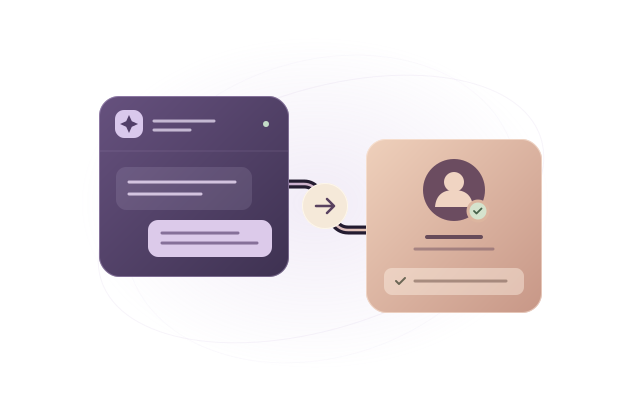
Start with real messages and their timestamps.
Separate observed numbers from possible lost opportunities.
Set expectations, clear the queue, and count again.
Start with the inquiries you can actually count
Before estimating anything, spend an evening pulling the real figures. You need four of them, and all four are already sitting in your phone or your books.
- How many inquiries you get in a month. Not customers, not jobs — first messages from someone who was not already a customer. Count a month back through WhatsApp, Instagram DMs, Messenger, the web form and the phone. Do it by hand; it takes twenty minutes and beats your memory.
- What share of them arrive outside working hours. Look at the timestamps. Count anything that landed after you closed, before you opened, or on a day you were shut. Weekends are usually where the surprise is.
- Your close rate on inquiries. Of the people who message you cold, how many end up paying you? Most owners guess high here. With no records, count the last twenty inquiries you can reconstruct.
- Your average ticket. Not your best job, not your headline service — the average of what an ordinary new customer actually spends the first time.
You now have enough to build an estimate. There is one number left, and it is the one you have to be honest about.
The number you have to guess
Of the inquiries that arrive when nobody answers, some share goes elsewhere. Not all of them: plenty of people wait, because they were messaging three businesses anyway, or because you came recommended. But some share does not wait, and you cannot observe it directly, because the people who leave do not tell you they left.
So you guess, you guess conservatively, and you write down that you guessed. A defensible method is to ask what you do yourself: when you message two plumbers at night and one answers in the morning and one three days later, which gets the job? Then pick a number lower than your instinct says, so the estimate is one you would defend out loud.
An estimate you built yourself from four real numbers and one stated assumption is worth more than a confident figure someone else calculated about businesses that are not yours.
A worked example
Here is the arithmetic on invented but plausible numbers for a small workshop. Everything in the "example" column is made up to show the calculation. The right-hand column is for yours.
| Input | Example | Your number |
|---|---|---|
| Inquiries per month | 60 | |
| Share arriving after hours | 35% (21 inquiries) | |
| Share of those that go elsewhere while waiting | 20% (4.2 inquiries on average) | |
| Close rate on inquiries you do answer | 25% (1 in 4) | |
| Average first-time ticket | $600 | |
| Monthly estimate | 4.2 × 25% × $600 = $630 |
The unrounded estimate is $630 a month in this made-up case. The 4.2 inquiries represent an expected average, not a count of individual people. Whether that is worth acting on depends entirely on your own inputs — run the same five lines with your figures and the answer might be a rounding error, or it might be more than your rent.
Two cautions. The "goes elsewhere" share is a guess, so treat the output as an order of magnitude, not a budget figure. And this counts only revenue you can name: not the customer who would have come back four times, not the reviews you never got. Those are real and not estimable, so leave them out of the number and keep them in mind separately.
What to do about it without buying anything
If the estimate turns out to matter, there are four changes worth trying first, in this order. None of them costs money and all of them are reversible.
- Set an autoresponder that makes a real commitment. A generic "thanks for your message" does not tell the customer what happens next. Say the specific thing instead: that you are closed, when you open, and that you will reply then. That gives the customer a clear expectation instead of an open-ended wait.
- Decide which questions actually need you. Go through last month's after-hours messages and sort them into two piles: questions that only you can answer, and questions with a fixed answer — hours, location, parking, whether you take a card, whether you handle that brand, roughly what a standard service runs. The second pile gives you a useful starting point for documented answers. Put those answers where people can find them: a pinned post, the business profile, an away message, an FAQ link.
- Block a fixed slot in the morning to clear the queue. Fifteen minutes at opening, before anything else, dedicated to overnight messages only. The point is that it happens every day at the same time rather than whenever there is a gap, because "whenever there is a gap" is how a message reaches 11 AM unanswered.
- Find out which channel they actually use. Owners are often wrong about this. If two thirds of after-hours inquiries arrive on Instagram and your notifications go to email, no amount of discipline will fix it. Check the channels from step one and put the notifications where the volume is.
Do these for a month and count again. Compare the inquiry volume and assumptions as well as the result; a lower estimate alone does not prove which change helped.
Where software comes in
The four steps above take you as far as one person's attention and a set of fixed answers can go. What they cannot do is hold an actual conversation at 11 PM — ask the follow-up question, collect the details you need to quote, and leave your team something to work with in the morning.
That is the specific gap Liveline was built for: answering on WhatsApp, Instagram and Messenger when nobody is at the desk, and handing the conversation to a person when one is needed. If your own estimate says the gap is worth closing, the plans are at the pricing page. If it says otherwise, the four steps still stand.
Put your own numbers into the after-hours calculator, then review how to transfer the conversations that need a person.